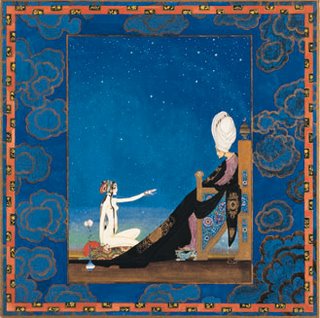
The collection of stories in One Thousand and One Arabian Nights are all held together by another story of Shaherazad telling them to King Shahryar. Because of a series of incredible events, he instates a policy of marrying a new maiden every night, and then having her executed the following morning. After a few years of this, the kingdom is running very low on eligible virgins.
But the wazir, whose job it is to find fresh girls has a wise, well-read, and beautiful daughter. She eventually convinces her father to offer her as the next bride in order that she may stop the slaughter. Indeed, after the marriage has been consummated, she begs the king to allow her to see her sister before her final dawn arrives. King Shahryad assents. When Shaherazad's sister arrives, she asks Shaherazad to tell her a story (as the two had previously planned) to while away the hours until dawn. Shaherazad begins a tale, but dawn interrupts her before she can finish. But the king is intrigued enough to put off the execution for one day in order to hear the ending. And so begins a cycle of storytelling. Every night, Shaherazad must tell another tale interesting enough to keep her alive. She nearly always ends the night in the middle of a tale, or at least with the promise of a tale that is even more wondrous.
After one thousand nights of telling (almost three years), Shaherazad has borne the king a son (or perhaps three; depends on the translation). She summons her children and asks the king to release her from her doom and not to leave his children motherless. Shahryad realizes that his wife is a wise and virtuous woman, and he relinquishes his oath. (Every relation and friend then gets robes of honors and new spouses and untold treasures; there is much merry making and honoring, and they all lived happily ever after.)
How do I spell thee? Let me count the ways: So goes the name of this fictional character. Apparently the early European translators spelled her name Scheherazade and Rimsky Korsikov wrote music with that title. Musical theater plays also go by that name. Wikipedia says a more correct spelling is Schehrazade. A number of entries in a Google search come up with Sheherazade, Sheherazad, and to us Shaherazad is the closest to how it is pronounced. All the ways of spelling her name are approximations from the original Arabic. Maybe we should have called ourselves Acme Afghans.
Illustration by Kay Nielsen from Scheherazade Telling the Tales (1922)